 |
| photo found here |
The number of Aboriginal people living in Canadian cities
has been stably increasing over the decades. According to Hanselmann, (2001)
more than half of Canada’s Aboriginal population lives in cities and two-thirds
of that population lives in Western Canada (as cited in Benoit, Carroll, &
Chaudhry, 2003, p. 822). Aboriginal women have been steadily migrating from
reserves to cities, often with their children. In fact, Frideres & Gadacz
(2012) affirm that many of these migrating women are living in poverty and are
often inclined to migrate to the city in hopes of finding employment (p.151). However,
Aboriginal women are less likely than Aboriginal men to find employment on and
off reserve; if they do find work, they will receive less money than their male
counterparts. Women migrating from reserves often do not have the education or
skills-training required to find adequate work in the city and often find
themselves and their children struggling with urban life (p.151).Poverty combined with a history of colonialism,
racism, and sexism has lead to an overrepresentation of Aboriginal women in the
Canadian sex trade, particularly in the city of Vancouver, where, in the downtown
east-side (VDES), many
Aboriginal women live. This paper will explore the
current realities faced by Aboriginal women in the sex trade within Vancouver’s
downtown eastside, how their overrepresentation in the sex trade is linked with
colonialism, and the ways in which Aboriginal women are working together for
change.
Aboriginal women are
overrepresented in the Canadian sex trade, particularly in the Vancouver’s
downtown eastside or VDES, a highly stigmatized community with high rates of
poverty and homelessness. According to Currie (1995) and
Hanselmann (2001), it has been estimated that 70 percent of the women in the
VDES sex trade are Aboriginal and that the average Aboriginal woman in the sex
trade is 26 years old, does not have a high school education and has three or
more children (as cited in Benoit et al. 2003, p. 824). Considering these
findings, it is essential to question our dominant notions of “free-choice”
when we discuss the sex trade. These notions of “free-choice” are questionable
and attempt to deflect from the realities that many of Aboriginal women face in
the sex trade.
Generally, poverty is
related to higher levels of homelessness, which is one of the main risk factors
for entering prostitution (Farley, Lynne & Cotton, 2005, p. 245).
In their study of 100 women in the sex trade in VDES, where over 50% of those
interviewed were Aboriginal, Farley et al. 2005 found that 86% of the women
reported experiencing past or current homelessness and that finding housing or
“a safe place” was among their most urgent needs (p.
250). Furthermore, of the women interviewed in this study, 95% of them
reported a desire to leave prostitution (p.253). The inequalities faced by
Aboriginal women, however, do not end with housing and economics, violence
against Aboriginal women is rampant, particularly in the VDES.
Aboriginal women living in VDES and all over Canada
for that matter, experience significantly more violence than non-Aboriginal women.
In the same study by Farley et al., (2005) Aboriginal respondents reported
higher levels of child physical and sexual abuse than those who identified as
European-Canadian, although both groups had high numbers (253). Further, as of
2005, according to Thompson, 60% of the fifty women missing from VDES were
Aboriginal and had been disappearing from the area since the late 1970s (as
cited in Schatz, 2010, p. 12). Furthermore, the NWAC (2004) states that Aboriginal
women are more likely to commit suicide, experience family violence, contract
HIV and even experience a higher mortality rate than non-Aboriginal women (as
cited in Kubik, Bourassa, & Hampton, 2009, p. 23). Violence and abuse often
leads to increased levels of substance abuse, cigarette smoking, and overall
poorer health (p. 27). In contemplating these grim realities, one must ask why Aboriginal women experience so much inequality
and further, how such inequality has lead to an increase in their representation
within the sex trade.
Canada’s history of colonialism has marginalized
Aboriginal people for centuries; however, Aboriginal women face even greater oppression,
being forced to contend with sexism and racism in their daily lives.
Colonialism has exacerbated Aboriginal women’s oppression in Canada, creating
what Voyageur (2000) calls a “double-jeopardy.” This doubled oppression produces
economic, political, and social barriers for Aboriginal women (as cited
in Kubik, et al., 2009, p. 24). Colonialism is also responsible for the Indian
Act which disenfranchised many Aboriginal women and the residential school
system which has had enduring consequences that carry on through generations
(p. 22). Structural oppression that stems from colonialism is utilized through
government policies which increase Aboriginal women’s vulnerability for poverty
and homelessness. Poverty and homelessness are two major factors that can
increase the likelihood of a woman entering the sex trade in order to survive. Despite
the inequalities that many Aboriginal women endure, such as being
overrepresented in the sex trade, they continue to resist oppression and
reclaim their identities and communities.
The debates surrounding prostitution are often
heated, many believe that full decriminalization of the sex trade is the best
way to deal with the industry, while others favour a model that targets the
“demand” and offers those who want to exit the resources to do so. This is often
referred to as the “Swedish Model” or “Nordic Model” (Longworth, 2010, p. 61). One particular group of
Aboriginal women who are active in this debate and many others that impact
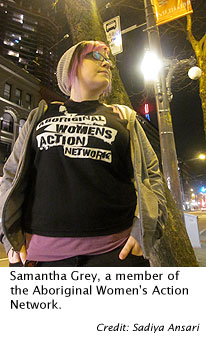
Aboriginal women is AWAN or the Aboriginal Women’s Action Network based in Vancouver.
AWAN asserts that Aboriginal women have “a long, multi-generational history of colonization,
marginalization, and displacement from our Homelands, and rampant abuses that
has forced many of our sisters into prostitution” (2009). The group is heavily
involved with the VDES community but is also still involved with Aboriginal
women living in rural communities or on reserves. In addition to challenging
the sex industry and the demand for Aboriginal women’s bodies, members of AWAN
(2009) also seek to challenge governments, support land claims and
self-government, increase representation of Aboriginal women through
networking, and reclaim their traditional values.
Aboriginal women are
overrepresented in the sex trade in Canada, particularly in VDES where poverty
and homelessness is rampant. The women represented in the VDES face more
violence, poverty, childhood sexual abuse, and homelessness than non-Aboriginal
women. Colonialism in Canada has proven to be unrelenting in its attempts to
destroy Aboriginal culture, creating a cycle of poverty that has had
significant implications for Aboriginal women. Through colonialism, Aboriginal
women lost their status if they chose to marry non-Aboriginal men and lost
their childhoods and even their own children to the residential school system.
Taking into consideration the incessant sexism and racism that Aboriginal women
still face, it should come as no surprise that Aboriginal women are fighting
against this overrepresentation of their sisters in the sex trade, viewing it
as a direct result of colonialism. Colonialism has propagated this poverty that
has lead to such an overrepresentation in the sex trade.
Consequently then, in order to
create change we must eradicate such poverty through provisions endorsing Aboriginal
people’s right to self-govern and reclaim their traditions and values.
Other
initiatives are offered by organized groups of Aboriginal women such as AWAN
and other feminist groups based in Vancouver. Groups such as AWAN believe that
the “Swedish model” would be the best option for women as it views prostitution
as violence against women rather than just another job (Longworth, 2010, p.
69). What kind of society accepts prostitution as work when so many are driven
into the sex trade due to lack of social, economic and political power? Groups
such as AWAN seek to understand the deeper structures that sustain such a
demand, “Let's not get tricked into a supposed fix which is not even a
band-aid, but only deepens the wounds” (AWAN, 2009). However,
as Kubik et al. (2009) highlights, the eradication of poverty and the emancipation
from the enduring impacts of colonialism can only occur when Aboriginal women
are valued, respected and treated as fully-human (p.31).
References
Aboriginal
Women's Action Network. (2009). Statement Opposing Legalized Prostitution &
Total Decriminalization of Prostitution. Retrieved March 24, 2012, from http://www.awanbc.ca/aboutus.html#Oppose
Benoit, C., Carroll, D., & Chaudhry,
M. (2003). In search of a Healing Place: Aboriginal women in Vancouver’s Downtown
Eastside. Social Science and Medicine,
56, 821-833.
Farley, M., Lynne, J., & Cotton, A.J. (2005). Prostitution
in Vancouver: Violence and the
Colonization of First Nations Women. Transcultural Psychiatry. 42(2), 242–271
doi: 10.1177/1363461505052667
Frideres, J. S., & Gadacz, R. R.
(2012.). Great Strides and New Challenges. Aboriginal Peoples in Canada (9th
ed., pp. 129-157). Toronto, Canada: Pearson.
Kubik,
W., Bourassa, C., & Hampton, M. (2009). Stolen Sisters, Second Class
Citizens, Poor Health: The Legacy of Colonization in Canada. Humanity &
Society, 33, 18-34.
Longworth,
C.E. (2010). Male Violence against Women in Prostitution: Weighing Feminist
Legislative Responses to a Troubling Canadian Phenomenon. Appeal, 15,
58-85.
Schatz,
D. (2010). Unsettling the Politics of Exclusion: Aboriginal Activism and the
Vancouver Downtown East Side. The Annual Meeting of the Canadian Political
Science Association, Session M10 (b) Beyond Statistics: Urban Indigenous
Politics. Retrieved from http://www.cpsa-acsp.ca/papers-2010/Schatz.pdf

Great paper! Love your sources, as well. There are some great studies being done in Minnesota in regards to Aboriginal women's issues, especially concerning the sex trade and colonialism.
ReplyDeleteHey BK, this is almostclever. Just wanted to share my new blog address with you so we don't lose connection. www.rootedinbeing.wordpress.com
ReplyDeleteThank you!!
ReplyDeleteThanks Sister for your work on fem*ist (sic) current.
ReplyDeleteriver
Great job!
ReplyDelete